
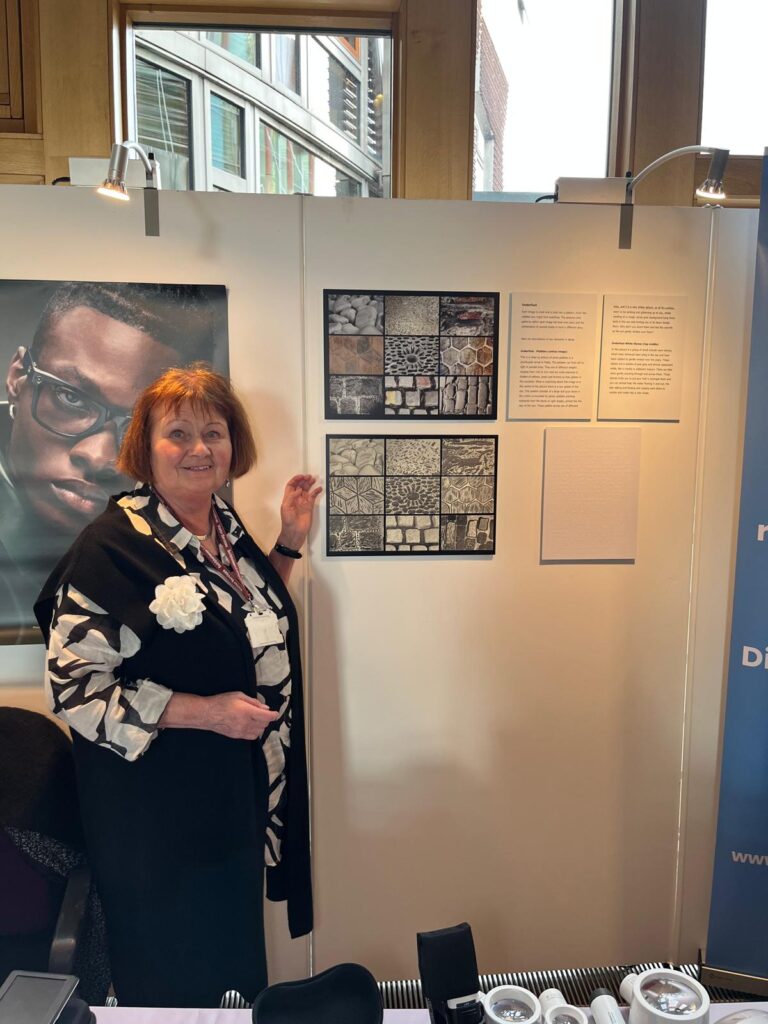
At our recent Scottish Parliament exhibition on Community Low Vision Services (CLVS), Optometry Scotland (OS) showcased the work of Anne Dignan, an artist living with dual sensory impairment. Anne’s story powerfully reflects the impact of sight loss and the importance of accessible care.
About Anne
Anne’s journey into creativity began long before her sight deteriorated due to a diagnosis of Macular Degeneration. Creativity shaped her daily life. As a former primary teacher, she enjoyed bringing stories to life for her pupils and encouraged creativity using simple materials like poster paints and sugar paper. When she had to leave teaching due to sight loss, she also lost an important part of her identity. Over time, that loss evolved into something new as she learned how to develop her creativity beyond sight.
Through oral storytelling Anne rebuilt her confidence and creative voice, learning stories by listening, recording and retelling them in her own way. With support from friends and organisations such as Sight Scotland, RNIB Scotland and Deafblind Scotland, Anne was able to explore different materials and techniques that allowed her to create art that could be experienced beyond sight alone.
Today, Anne creates multi-sensory art, designed to be explored through touch, sound and imagination. Her work challenges the assumption that art is purely visual and opens it up to a wider audience. Anne’s creative process embraces senses like touch, sound, imagination, and even explores taste and smell. That’s what the collection, ‘Interactive Harmony 2’, displayed at the Optometry Scotland exhibition in the Scottish Parliament reflects.
Anne notes that despite challenges there have been positives, including finding purpose in sharing her experience, “Sight loss needn’t be a complete barrier to communicating with others. It is a matter of reframing it in a way that is tailored to individual needs.”
The Impact of Sight Loss
Her experience also highlights the realities of living with sight loss. Reading and fine tasks can become difficult for those experiencing sight loss. This often affects the everyday hobbies people enjoy.
Sight loss further impacts life everyday tasks. Many people experiencing sight loss find everyday tasks such as navigating spaces, shopping or cooking challenging. These tasks often require adaptation.
Anne notes the challenges she personally faces, relying on her cane to navigate spaces safely. She notes the importance of assistive technology and notes tools such as audio features and aids are invaluable.
However, for people experiencing sight loss, many materials produced both online and in the real world can be inaccessible. There are significant barriers to access with access to materials as assistive technology and the aids and needs of users differ from person to person. Anne urges a holistic approach to accessible materials, commending organisations like Sight Scotland, RNIB Scotland and Deafblind Scotland who prioritise this.
Current Services
Across Scotland low vision services are a postcode lottery, many low vision services are currently based in increasingly busy hospital Ophthalmology departments. Some health boards, including NHS Lanarkshire and NHS Ayrshire and Arran, provide services through local schemes within community optometry but this is not a reality for everyone in Scotland.
Many people accessing these services often experience long waits and significant barriers to travel when accessing services. Anne notes how these barriers can affect and deter people from receiving access to vital support that helps those experiencing sight loss adapt and maintain independence.
RNIB Scotland’s recent estimates note that in Scotland, the direct cost of eye health and sight loss to the NHS is £386.49 million every year, with the wider economic impact estimated at £2.33 billion. With sight loss set to rise across the UK and more than double by 2050, these figures underline both the scale of need and the importance of delivering care in a more sustainable and accessible way.
A community based low vision service (CLVS) offers a clear solution. By providing care locally, patients can access support quicker and closer to home. In addition, CLVS would significantly reduce pressure on hospital services while improving outcomes for those experiencing sight loss.
Community optometry practices are well equipped and able to help patients experiencing sight loss. Community optometrists and dispensing opticians can assist beyond diagnosis and management, allowing patients to receive support and maintain their independence.
In Anne’s own words “it’s a no brainer, having access to support is vital, but being able to get support on your doorstep is life changing.”
The Bigger Picture
Anne’s story is a reminder that sight loss affects far more than vision. With the right support, people can continue to create, connect and live well. Community optometry has a vital role to play in making that a reality through a Community Low Vision Service.
Thank you
We want to thank Sight Scotland for their assistance with this blog.
And thank you to Anne herself, for her contribution to our OS Parliamentary Exhibition and blog, and for her continued commitment to advocacy and creativity.